
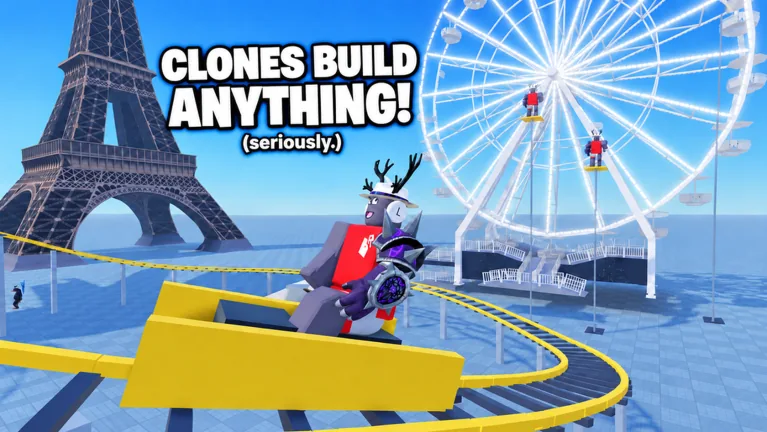
Make the big shape work before adding detail
For CLONE BUILDERS large builds, choose one feature that makes the project recognizable and test a smaller version first. A tower needs a clear vertical body. A Ferris wheel needs a readable circular outline. A shuttle needs a distinct body and wings. If the main shape is confusing, decorative pieces will make the next result harder to judge.
The clones use a structured building system to place, resize, move, and assemble parts. A large project gives you more changes to follow. Check whether you can still describe the object taking shape as construction progresses.
Write a short project brief
Before you begin, describe the desired result in one sentence and choose two visual priorities. For a landmark tower, those priorities could be a narrow upright body and a contrasting top. For an amusement build, they could be a wheel outline and enough surrounding space to see it.
This brief is a planning exercise, not guaranteed input syntax. Use the live experience’s controls for the actual idea. Keep a separate list of decorative wishes so they do not overwhelm the first test. One recognizable focal point is easier to improve than five landmarks competing for attention.
| Project decision | Keep first | Leave until later |
|---|---|---|
| Overall shape | One recognizable silhouette | Several competing landmarks |
| Proportions | A clear relationship between main parts | Tiny decorative measurements |
| Surroundings | Space to view or test the object | Dense scenery around every edge |
| Group goal | One agreed result | A different design from each player |
Test scale as a design choice
Start with a modest version of the idea and let the clones progress. Compare the shape at several stages. A temporary mass of parts can become clearer as pieces move and assemble, so do not judge only the first few seconds of construction.
After the test, identify the most important mismatch. If the tower looks broad instead of tall, concentrate the next idea on its vertical silhouette. If a wheel-shaped project looks like an indistinct block, simplify the surrounding structures. Changing one aspect gives you a comparison you can actually use.
Do not assume that a successful small result guarantees an identical larger result. The game is experimental. Keep checking whether the enlarged idea preserves the feature you liked in the first version. This is especially useful when a recognizable object depends on the relationship between several parts.
Organize a quieter session
The developer recommends a private server for large-scale builds and minigames. Check current availability, access, and price on Roblox, then make sure your intended group can join before scheduling a long session. Read the private-server planning guide if the group needs a shared plan.
Give players informal responsibilities. One can watch the construction sequence, one can inspect the silhouette, and one can test how a finished layout reads from ground level. These informal roles help players focus on a task. They do not grant game classes or building permissions.
Decide when the project is finished enough
Choose a stopping point before the session becomes an endless list of additions. For a showcase, the goal can be a recognizable object viewed from three directions. For a player-run course, the goal can be a route another player can follow without coaching.
When construction becomes strange, reduce the next experiment to the main shape rather than searching for an invented size limit or upgrade. You can also switch to a smaller tower exercise to isolate proportions. Use that smaller test to decide what to change in your next large attempt.
FAQ
Is there a confirmed maximum build size?
Use the limits and options currently shown in the game. Do not plan around a numerical cap copied from another building experience.
Should I use a private server for large builds?
The developer recommends it. Check the current Roblox listing and access settings before arranging the session.
Why does my bigger idea look less clear?
Compare its main proportions and surrounding detail with a smaller attempt. Simplify one aspect of the next design so you can identify the difference.
Should I add details before the main shape finishes?
First judge the completed main shape. Adding more decoration will not make an unclear silhouette recognizable.