
Start with a rule that fits one simple layout
For CLONE BUILDERS minigames, begin with a challenge players can explain in one sentence: reach the exit, follow a route, or identify the main object in a showcase. Then design the smallest layout that supports that rule. If no one knows how to win, a complicated arena gives the group plenty to look at without a clear game to play.
The developer recommends a private server for minigames and large-scale builds. Consider one when you organize a group session. Do not assume every creation has an automatic timer, scoring system, checkpoints, or a dedicated competitive mode. The ideas here are design exercises with rules your players agree on.
Separate the building goal from the game rule
The building goal describes the object you want the clones to construct. The game rule describes what players agree to do around the finished result. Keep those two decisions separate so a strange construction result does not leave everyone guessing how to play.
For a maze, the building goal is a readable arrangement of passages. The rule is to get from the chosen entrance to the chosen exit. For a route challenge, the building goal is a sequence players can inspect; the rule defines where an attempt starts and what ends it. Check the live game’s available tools before relying on any automatic feature.
| Design exercise | Simple player-run rule | What to test first |
|---|---|---|
| Maze | Reach the agreed exit | One solvable path from entrance to exit |
| Obstacle route | Complete the agreed sequence | Each obstacle separately |
| Track layout | Follow the route to the finish | Whether turns and boundaries are readable |
| Building showcase | Compare one chosen visual feature | Whether everyone can see that feature |
Agree on rules before the first attempt
- Identify the start and finish together. Do not leave those points to interpretation after someone starts.
- Decide what counts as a failed attempt. For a route, that could be leaving the agreed path.
- Decide whether players take turns or move together. Use turns when crowding makes the route hard to inspect.
- Choose how results are recorded. A person can keep a simple tally; do not promise an in-game scoreboard.
- Explain how the group will handle an unclear result. Repeat the test after clarifying the rule.
Keep the first round short enough that you can change the layout or the rule afterward. A small trial reveals more than a long competition built around an untested course.
Test with someone who did not design it
Ask another player to follow the route without constant directions. Watch where they hesitate, choose the wrong turn, or misunderstand the finish. Clarify the layout or the rule at that spot before making the route harder. Players should be working through the challenge, not trying to guess how it works.
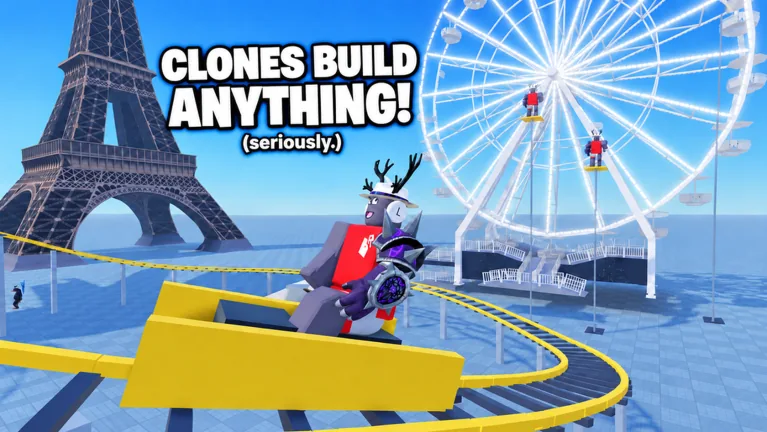
The clones place, resize, move, and assemble parts through an experimental structured system. Judge the finished construction you actually have. If a result differs from your plan, simplify the next design instead of inventing rules to disguise every mismatch.
Keep the session focused
Check the official experience’s private-server availability, current price, and access options before organizing everyone. Give one player responsibility for explaining the rules and another for observing the first test. These are informal roles your group chooses.
Once the simple version works as a group activity, add one extra decision: a branch in a maze, another obstacle, or a more distinctive finish. Use the maze design exercise for route planning or the obstacle-course exercise for testing a sequence. Make sure each addition serves the challenge you want players to try.
FAQ
Are these official built-in minigame modes?
These are player-run design exercises. Use the live game to check any specific automatic mode or scoring feature before depending on it.
Should minigames use a private server?
The developer recommends one. Check current availability, price, and group access on the official Roblox experience first.
How do we keep results fair without a scoreboard?
Agree on the start, finish, failure rule, and turn order. Have one player record results consistently for the group.
Why is the first test more important than extra obstacles?
A short test reveals unclear routes and rules. Fix those before adding difficulty so players understand the challenge they are attempting.