
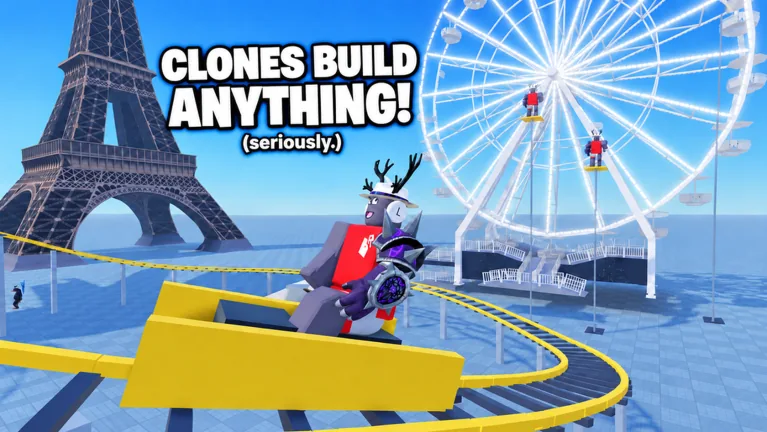
Test each challenge before connecting the whole course
Start your CLONE BUILDERS obstacle course with a readable route and a few challenges you can inspect separately. Test each section, then test the sequence from start to finish. This is a player-run design exercise, not a confirmed obby mode, checkpoint system, or guaranteed construction preset. Use the actual creation to decide what a fair attempt involves.
A course has two different jobs: show players where to go and give them something to do along that route. If the direction is unclear, adding harder obstacles turns navigation confusion into the main challenge. Fix readability first.
Choose the route before the difficulty
Agree on a start, a finish, and the order of the sections. Keep the first goal short enough that you can walk through it and explain each part. A single confusing transition is easier to identify in a modest layout than in a sprawling first attempt.
Use the live game’s controls for the construction idea. NPC clones place, resize, move, and assemble parts through an experimental structured system. Describing an obstacle gives you a design goal. It does not guarantee a particular jump distance, collision behavior, or automatic fail condition in the result.
| Course decision | First target | Test question |
|---|---|---|
| Start | One agreed beginning | Do all players start consistently? |
| Section order | A readable sequence | Can a new player identify the next step? |
| Individual challenge | One testable action | Can the actual section be completed? |
| Finish | One clear stopping point | Can the group judge success without debate? |
Inspect the actual sections individually
Let construction develop before testing pieces that are still changing. Once you can inspect the result, approach one section at a time. Check its entry, the action the layout requires, and where a player ends up afterward. Then check the connection to the next section.
Do not use a made-up measurement as proof of difficulty. Judge the actual result in the current session. If the section is unusable, focus the next design attempt on a simpler version. If it works but the next destination is unclear, focus on the transition instead.
Keep a short observation for each problem. If the landing is hard to identify, focus on its design. If players cannot reach the next section, test that connection again. Check these specific problems before calling the entire course impossible.
Run the full route with a new player
After the sections work separately, ask someone who did not design the course to try the sequence without constant directions. Watch where they hesitate or misunderstand the order. A successful designer run does not tell you whether the layout communicates its rules to everyone else.
If a later section depends on a precise setup that players cannot infer, simplify the design or explain that rule before the attempt. Keep the challenge consistent rather than changing the permitted route after someone has already started.
Agree on failure and restart rules
Choose what counts as a failed attempt, where the player begins again, and whether others take turns. These are group agreements. Do not promise an automatic checkpoint, death zone, score counter, or timer unless the live experience actually offers the feature you plan to use.
The developer recommends a private server for minigames and large builds; inspect current availability, price, and group access on Roblox. Read the minigame planning guide for consistent rules. If you want branching choices instead of a sequence of obstacles, compare the maze exercise.
FAQ
Is this a built-in obby mode?
Treat this as a player-run design exercise. Check the live options before expecting a dedicated obby mode or a guaranteed obstacle-course preset.
Should I test the whole course immediately?
First inspect and test each section separately. Then test the connections and the complete start-to-finish sequence.
Are checkpoints guaranteed?
No. Check the live experience for any feature you need. Otherwise agree on a manual restart rule with the group.
How do I improve a confusing section?
Identify whether the problem is access, the required action, or the next destination. Simplify that one design priority in the next attempt.