
Make the route readable before calling it a race
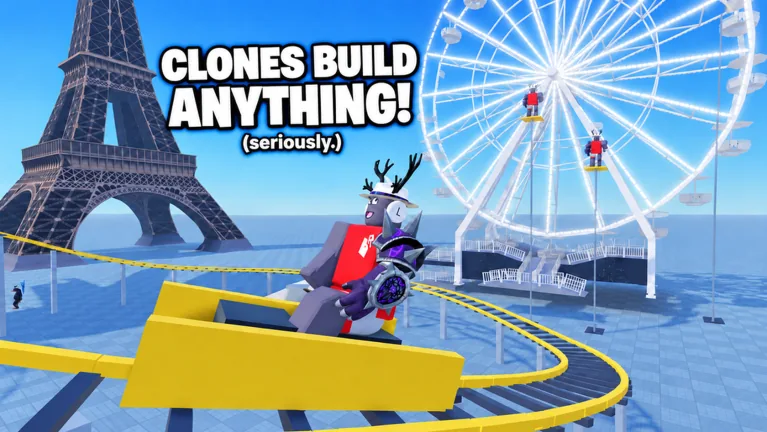
For a CLONE BUILDERS track build, choose a simple route with an obvious start, a few clear turns, and a recognizable finish. The official illustration includes a yellow track-shaped creation. Use that visual idea as inspiration for a route-design exercise, then test the actual result on foot before organizing a player-run challenge. A track shape does not establish working vehicles, automatic timers, or a racing mode.
Start by checking navigation. Another player should know where to go without an explanation at every turn. If the route is confusing, speed or extra corners will make the problem harder to inspect.
Choose an open route or a loop
An open route gives you separate start and finish locations. A loop asks players to recognize where a lap begins and ends. Pick one structure before adding decorative surroundings, and explain it to your group before the first test.
Use these choices to plan the route; they do not promise built-in track settings. Enter the construction idea through the current game controls and judge the layout the clones assemble. Keep the first version short enough for one player to inspect the entire sequence.
| Route feature | First design target | Playtest question |
|---|---|---|
| Start | One agreed beginning | Does everyone begin at the same place? |
| Turns | A small number of distinct changes | Can a new player see the next direction? |
| Boundaries | A route distinguishable from its surroundings | Is it clear when someone leaves the path? |
| Finish | One agreed stopping point | Can the group judge completion consistently? |
Walk the finished result before adding rules
Follow the route slowly from the agreed start. Watch where the next segment becomes hard to identify, where an apparent connection does not work in the actual layout, or where a shortcut changes the intended challenge. Inspect those locations before asking players to compete.
The NPC clones place, resize, move, and assemble parts. Let construction develop before testing a route that is still visibly changing. Check whether you can move between connected-looking sections. Two shapes can look close in a picture without providing a usable path.
If a turn reads poorly, simplify that part of the next design. If the finish blends into surrounding scenery, make the stopping point clearer in the next idea or choose an unambiguous player-agreed location in the current layout.
Write simple rules for the group
Define the start, finish, and permitted route. Agree on what counts as leaving the path and whether players take turns. If you time attempts yourself, use the same method for everyone and explain how you will handle an unclear result. Your group handles this timing manually; the exercise does not promise an in-game timer.
Avoid relying on a vehicle just because the project looks like a track. First check what the live experience and the actual creation support. A walking route can be a complete player-run activity without inventing a driving feature.
Add complexity only when the route works
After another player completes the route without coaching, add one new decision. That could be a clearer turn sequence or a more distinctive surrounding landmark. Keep the route visible enough that decoration supports navigation instead of hiding it.
The developer recommends a private server for large builds and minigames; check current availability and price before organizing a larger group. Use the minigame planning guide for rules, or the obstacle-course exercise when you want a sequence with individual challenges.
FAQ
Does a track-shaped build include a working vehicle?
Do not assume it does. Check the live experience and test the actual creation before planning a driving challenge.
Should the first track be a loop?
Either a loop or an open route can be a design goal. Choose the structure first and make the start and finish clear to the group.
How do I know whether the route is readable?
Ask someone who did not design it to follow it without directions. Watch where they hesitate or leave the intended path.
Does the game automatically time these challenges?
This exercise does not establish an automatic timer. If your group records times manually, use one consistent method and agreed rules.