
Give the house a clear body and a distinct roof
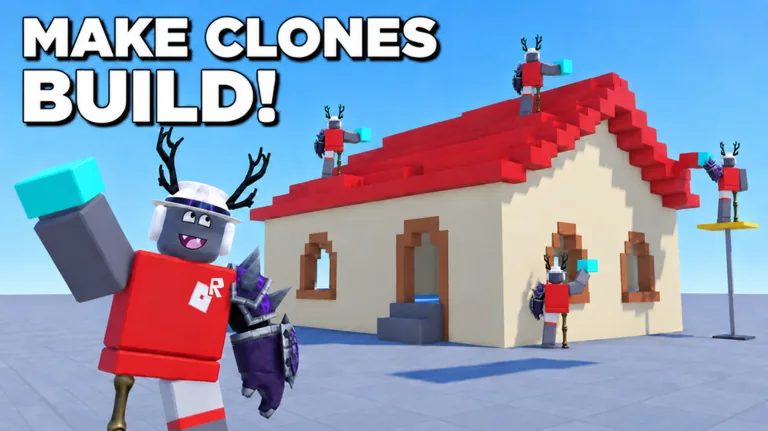
Start your CLONE BUILDERS house with a small wall-shaped body and a roof you can distinguish from it. The official house illustration uses cream walls and a red roof, making those two masses easy to read. Use that contrast as inspiration for a modest design exercise, rather than treating the image as a guaranteed preset or an exact instruction the clones must reproduce.
A house becomes recognizable through the relationship between its main forms. Windows, fences, and garden details can wait. If the roof and body do not read clearly together, more decoration makes the next comparison harder.
Choose two features before the first attempt
Decide what should make this house recognizable. A simple choice is a broad body beneath a contrasting roof. Another is a compact cottage shape with an obvious front. Keep the first goal narrow enough that you can describe the result without listing a dozen missing accessories.
These are design suggestions, not special command syntax. Use the current experience’s controls to enter or choose your idea. The NPC clones construct through placing, resizing, moving, and assembling parts; the game does not promise that every descriptive phrase becomes a precise architectural plan.
| Design feature | First target | Detail to postpone |
|---|---|---|
| Body | One compact, readable mass | Several attached wings |
| Roof | A shape distinct from the walls | Complicated roof sections |
| Front | A direction you can identify | Dense landscaping |
| Surroundings | Space to inspect the house | A whole neighborhood |
Watch proportions as the construction develops
Let the clones progress before judging an early collection of parts. Watch how the body and roof change size and position, then compare their relationship in the finished result. Check whether you can identify the house from its outline.
If the roof dominates everything, choose a simpler body-and-roof relationship for the next idea. If the roof blends into the walls, focus the next test on making the top visually distinct. Keep the object similar between tests so you can see what changed.
Compare broad, narrow, tall, and compact shapes to decide what to change next. You do not need exact dimensions for this exercise, and you should not assume the game offers an editable measurement field.
Inspect the house from more than the front
Look at the result from the front, side, and a position where the full outline is visible. A house that reads clearly from one direction can look like an indistinct block from another. Choose the view where the main relationship is hardest to understand and use that as the focus of your next design test.
If you intend players to move around or through the creation, test the actual finished layout. A picture of a doorway-shaped feature does not guarantee a usable entrance or interior. Judge the space your session actually produced before arranging a group activity around it.
Expand only after the small house works as a shape
Once the main forms are readable, choose one addition with a clear job: a secondary section, a more distinctive top, or a small surrounding feature. Avoid adding all three at once. Each attempt should answer one design question.
For a larger neighborhood idea, first read the large-build planning guide. For an even simpler silhouette comparison, try the tower exercise. A finished small house is a useful starting point because you can explain what worked before scaling the project up.
FAQ
Is the red-roof house a guaranteed preset?
The official illustration shows that design. Use it as inspiration, and check the live options before treating it as a preset or a guaranteed input phrase.
What should I prioritize in my first house?
Choose a readable body and a distinct roof. Those two features communicate the object before smaller decorations do.
Should I build the whole neighborhood immediately?
Start with one small house. Compare its main proportions before expanding the idea into several buildings and surrounding scenery.
Does a house-shaped creation guarantee an interior?
No. Test the actual finished layout before assuming players can enter or use every architectural feature.